
From the Team: This post was originally written by Chase Eskelsen, Board Chair of ParagonED, and published on www.FerskenED.com. We’re sharing it here because it reflects the heart and vision behind ParagonED.
One of the most damaging assumptions in modern education and parenting is also one of the most common:
“They’re just kids.”
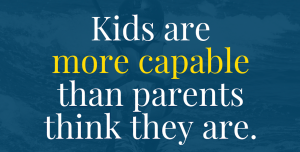
We use that phrase to excuse low expectations, delayed responsibility, watered-down challenges, and endless extensions of childhood. And while it sounds compassionate, it’s often the opposite. Far too often, we are underestimating what kids are capable of—and then we’re surprised when they fail to rise.
- Parents baby them too long.
- Schools hesitate to push them.
- Church youth groups keep treating teenagers like oversized elementary students.
And culture reinforces it all by telling kids to “just enjoy being a kid” while quietly robbing them of meaningful responsibility, purpose, and ownership.

Kids Rise (or Sink) to Expectations
When adults assume kids can’t handle responsibility, pressure, or real-world problems, kids internalize that message. They stop trying to exceed expectations because there are no expectations to exceed.
But history—and experience—tells a very different story.
Kids don’t need less challenge. They need better challenge.
When we trust young people with real work, real thinking, and real stakes, something incredible happens: they surprise us.
A Brief Look Back: Kids Were Never Meant to Be Sheltered
Historically, adolescence wasn’t a holding tank. It was a launchpad.
-
Alexander the Great was commanding armies by his early 20s—and being trained for leadership long before that.
-
Blaise Pascal, one of the greatest mathematicians of all time, made major discoveries as a teenager.
-
Benjamin Franklin was running his own printing business at 17.
-
Even in more recent history, farm kids, apprentices, and tradesmen were expected to contribute meaningfully well before adulthood.
Were those eras perfect? No. But they understood something we’ve largely forgotten: capability grows when responsibility grows.
Where We’re Falling Short Today
-
Parents, with the best intentions, often rescue kids from discomfort too quickly—solving problems they should struggle through.
-
Schools are constrained by systems that prioritize compliance, pacing guides, and test preparation over challenge and ownership.
-
Church youth groups sometimes unintentionally delay spiritual maturity by entertaining teens instead of discipling them.
The result?
A generation that is intelligent, informed, and well-resourced—but often under-challenged and under-prepared.
So What Does “Raising the Bar” Actually Look Like?
If we truly believe kids are capable of more, we have to give them places to prove it. Here are a few environments where kids routinely outperform society’s low expectations:
1. Real Business & Entrepreneurship
When students run actual businesses—managing money, customers, failure, and success—they mature quickly. Ownership changes everything. Kids stop asking, “Is this graded?” and start asking, “Does this work?”
2. Microschools & Alternative Education Models
Smaller learning environments allow students to move faster, go deeper, and take responsibility for their learning. When students are trusted with autonomy, they often exceed what traditional systems expect of them.
3. Leadership in Service & Community
Whether it’s mentoring younger students, leading service projects, or organizing initiatives, kids grow when their contribution matters. Responsibility breeds confidence.
4. Serious Skill Development
Coding, trades, public speaking, finance, athletics, music—when kids are allowed to pursue mastery instead of checking boxes, they often reach levels adults never thought possible.
The Real Risk Isn’t Pushing Too Hard
The real risk isn’t that we’ll expect too much of kids.
The real risk is that we’ll expect too little—and they’ll believe us.
It’s time to stop asking, “Are they ready?” And start asking, “What would happen if we trusted them?”
Because the truth is simple—and a little uncomfortable:
Kids are ready for more. The question is whether adults are willing to give it to them.
Leave a Reply